

How To Draw A Paper Clip
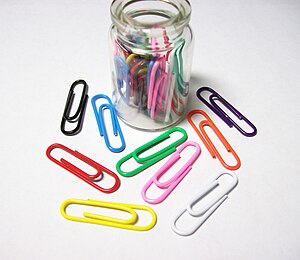
A few paper clips of different colors coated in a mix of plastic and safety
A paper prune (or paperclip) is a device used to hold sheets of paper together, commonly made of steel wire bent to a looped shape (though some are covered in plastic). Most paper clips are variations of the Gem type introduced in the 1890s or before, characterized by the most two full loops made by the wire. Common to paper clips proper is their utilization of torsion and elasticity in the wire, and friction between wire and newspaper. When a moderate number of sheets are inserted betwixt the 2 "tongues" of the prune, the tongues will be forced apart and cause torsion in the bend of the wire to grip the sheets together.
Shape and limerick [edit]
Newspaper clips usually have an oblong shape with straight sides, but may also be triangular or circular, or have more elaborate shapes. The near common fabric is steel or another metal, only molded plastic is likewise used. Some other kinds of paper clips utilise a two-piece clamping system. Recent innovations include multi-colored plastic-coated paper clips and spring-fastened folder clips.[one]
History [edit]
Co-ordinate to the Early Office Museum, the offset patent for a bent wire paper clip was awarded in the United States to Samuel B. Fay in 1867. This clip was originally intended primarily for attaching tickets to fabric, although the patent recognized that information technology could exist used to attach papers together.[2] Fay received U.S. patent 64,088 on April 23, 1867. Although functional and practical, Fay's blueprint along with the fifty other designs patented prior to 1899 are not considered reminiscent of the mod paperclip design known today.[3] Another notable paper clip design was as well patented in the Us by Erlman J. Wright on July 24, 1877, patent #193,389. This clip was advertised at that time for use in fastening together loose leaves of papers, documents, periodicals, newspapers etc.[two]
The most common type of wire paper clip still in employ, the Gem paper clip, was never patented, but it was most likely in production in Britain in the early 1870s by "The Precious stone Manufacturing Company", according to the American expert on technological innovations, Professor Henry J. Petroski.[4] He refers to an 1883 article about "Gem Paper-Fasteners", praising them for being "better than ordinary pins" for "binding together papers on the same bailiwick, a bundle of letters, or pages of a manuscript".[5] Since the 1883 article had no analogy of this early "Gem", it may have been different from modern paper clips of that name.
The earliest analogy of its current form is in an 1893 advertisement for the "Jewel Paper Clip".[half dozen] [7] [8] In 1904 Cushman & Denison registered a trademark for the "Gem" name in connection with paper clips. The declaration stated that information technology had been used since March 1, 1892, which may take been the time of its introduction in the United States.[7] Paper clips are still sometimes chosen "Gem clips", and in Swedish the word for any paper prune is "gem".
Definite proof that the modernistic type of newspaper clip was well known in 1899 at the latest, is the patent granted to William Middlebrook of Waterbury, Connecticut on April 27 of that year for a "Automobile for making wire paper clips." The drawing clearly shows that the product is a perfect clip of the Gem type.[nine] [10] The fact that Middlebrook did not mention it past proper noun, suggests that it was already well known at the time. Since then countless variations on the same theme have been patented. Some take pointed instead of rounded ends, some have the end of one loop bent slightly to brand it easier to insert sheets of paper, and some have wires with undulations or barbs to get a meliorate grip. In improver, purely aesthetic variants have been patented, clips with triangular, star, or round shapes.[11] Only the original Jewel type has for more than than a hundred years proved to exist the about practical, and consequently by far the most popular. Its qualities—ease of utilize, gripping without trigger-happy, and storing without tangling—have been hard to ameliorate upon. National Paperclip Day is May 29.[12]
The Precious stone-type paperclip has become a symbol of inventive pattern, as confirmed below – although falsely – by its commemoration as a Norwegian invention in 1899. More convincing is its appropriation as logo of the Twelvemonth of Pattern ( L'whatever del disseny ) in Barcelona 2003, depicted on posters, T-shirts and other merchandise.
-

Small metal paper clip, with measure in centimetres
-
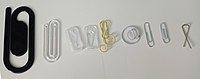
Assorted paperclip shapes, sizes, and designs
-

Middlebrook 1899 patent for a paper clip machine showing that the Gem was already in common use (top and lesser)
-

GEM Paper Prune advertisement, Jan 1893, by Cushman & Denison
-
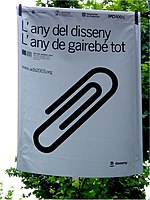
Paper clip icon on poster advertising the Year of Design in Barcelona 2003
Unsupported claims [edit]
It has been claimed that the newspaper clip was invented by English intellectual Herbert Spencer (1820–1903).[13] [14] [15] Spencer registered a "binding-pivot" on 2 September 1846,[16] [17] which was fabricated and sold by Adolphus Ackermann for over a year,[18] advertised every bit "for holding loose manuscripts, sermons, weekly papers, and all unstitched publications".[16] Spencer'south blueprint, approximately xv cm (5.ix in) unfolded, looked more than like a modern cotter pin than a modernistic paper clip.[16]
Norwegian claim [edit]
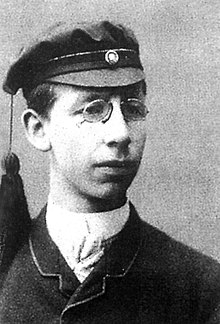
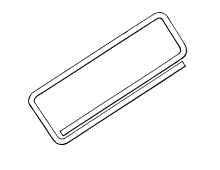
The paper prune patented by Johan Vaaler in 1899 and 1901
Norwegian Johan Vaaler (1866–1910) has erroneously been identified as the inventor of the paper clip. He was granted patents in Germany[xix] and in the United States[twenty] (1901) for a newspaper prune of similar blueprint, but less functional and practical, because information technology lacked the terminal plough of the wire. Vaaler probably did not know that a better product was already on the market, although not yet in Norway. His version was never manufactured and never marketed, because the superior Gem was already available.
Long later Vaaler's death his countrymen created a national myth based on the simulated assumption that the paper clip was invented by an unrecognised Norwegian genius. Norwegian dictionaries since the 1950s accept mentioned Vaaler as the inventor of the newspaper clip,[21] and that myth subsequently institute its way into international dictionaries and much of the international literature on paper clips.
Vaaler probably succeeded in having his design patented abroad, despite the previous being of more useful paper clips, because patent authorities at that time were quite liberal and rewarded any marginal modification of existing inventions.[22] Johan Vaaler began working for Alfred J. Bryns Patentkontor in Kristiania in 1892 and was later promoted to office manager, a position he held until his expiry.[23] As the employee of a patent function, he could easily have obtained a patent in Kingdom of norway. His reasons for applying abroad are not known; it is possible that he wanted to secure the commercial rights internationally. Also, he may accept been aware that a Norwegian manufacturer would observe it difficult to introduce a new invention away, starting from the minor home market.
Vaaler'south patents expired quietly, while the "Jewel" was used worldwide, including his own country. The failure of his design was its impracticality. Without the two full loops of the fully adult newspaper prune, it was hard to insert sheets of newspaper into his clip. 1 could manipulate the end of the inner wire so that it could receive the sheet, but the outer wire was a expressionless end considering it could non exploit the torsion principle. The clip would instead stand out like a keel, perpendicular to the sheet of paper. The impracticality of Vaaler'southward design may easily be demonstrated by cutting off the terminal outer loop and ane long side from a regular Precious stone clip.
National symbol [edit]
The originator of the Norwegian paper clip myth was an engineer of the Norwegian national patent agency who visited Germany in the 1920s to annals Norwegian patents in that country. He came across Vaaler'south patent, but failed to detect that it was non the same as the then-common Jewel-type clip.[24] In the written report of the first fifty years of the patent agency, he wrote an article in which he proclaimed Vaaler to be the inventor of the common paper prune.[25] This slice of data plant its way into some Norwegian encyclopedias after World War Two.
Events of that war contributed profoundly to the mythical status of the newspaper clip. Patriots wore them in their lapels as a symbol of resistance to the German occupiers and local Nazi authorities when other signs of resistance, such as flag pins or pins showing the nil of the exiled King Haakon 7 of Norway were forbidden. Those wearing them did not nevertheless come across them as national symbols, as the myth of their Norwegian origin was not ordinarily known at the time. The clips were meant to denote solidarity and unity ("nosotros are bound together"). The wearing of paper clips was soon prohibited, and people wearing them could chance severe punishment.[26]
The leading Norwegian encyclopedia mentioned the part of the paper prune as a symbol of resistance in a supplementary volume in 1952, but did not withal proclaim information technology a Norwegian invention.[27] That information was added in later editions. According to the 1974 edition, the idea of using the paper prune to announce resistance originated in French republic. A clip worn on a lapel or forepart pocket could exist seen as "deux gaules" (two posts or poles) and exist interpreted every bit a reference to the leader of the French Resistance, General Charles de Gaulle.[28]
The post-war years saw a widespread consolidation of the paper clip as a national symbol. Authors of books and manufactures on the history of Norwegian applied science eagerly seized it to make a sparse story more substantial. They chose to overlook the fact that Vaaler's clip was not the same as the fully adult Gem-type clip.[29] In 1989 a giant newspaper clip, almost 7 k (23 ft) high, was erected on the campus of a commercial college about Oslo in accolade of Vaaler, ninety years after his invention was patented. Merely this monument shows a Jewel-type clip, not the one patented by Vaaler. The celebration of the alleged Norwegian origin of the newspaper clip culminated in 1999, 1 hundred years later Vaaler submitted his application for a German patent. A commemorative postage was issued that year, the outset in a series to draw attention to Norwegian inventiveness. The background shows a facsimile of the German "Patentschrift". Notwithstanding, the figure in the foreground is non the newspaper clip depicted on that document, only the much better known "Precious stone". In 2005, the national biographical encyclopedia of Norway (Norsk biografisk leksikon) published the biography of Johan Vaaler, stating he was the inventor of the paper clip.[30]
-

The giant newspaper clip in Sandvika, Norway. It shows the Jewel, not the i patented by Vaaler.
-
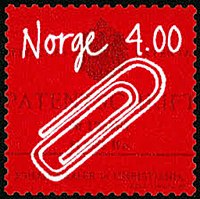
Postage stamp stamp issued in 1999 to commemorate Vaaler's paper clip. In the background his German language "Patenschrift". 1901. The depicted paper clip is non the ane he invented, but the successful Precious stone clip.
Other uses [edit]
Wire is versatile in its nature. Thus a paper clip is a useful accessory in many kinds of mechanical work, including reckoner piece of work: the metal wire can be unfolded with a little force. Several devices call for a very thin rod to push a recessed button which the user might only rarely need. This is seen on most CD-ROM drives as an "emergency eject" should the power fail; as well on early on floppy disk drives (including the early Macintosh). Various smartphones require the utilise of a long, thin object such as a paper clip to squirt the SIM card and some Palm PDAs advise the use of a paper clip to reset the device. The trackball can be removed from early Logitech pointing devices using a paper clip equally the key to the bezel. A paper prune bent into a "U" can exist used to start an ATX PSU without connecting it to a motherboard (connect the light-green to a black on the motherboard header). One or more paper clips tin can brand a loopback device for a RS232 interface (or indeed many interfaces). A paper clip could exist installed in a Commodore 1541 deejay bulldoze as a flexible caput-stop. The steel wire from a paperclip can be used in dentistry to course a dental post.[31]
Paper clips can be aptitude into a crude only sometimes effective lock picking device.[32] Some types of handcuffs tin can be unfastened using paper clips. There are two approaches. The beginning one is to unfold the clip in a line and and so twist the finish in a correct bending, trying to imitate a key and using it to lift the lock fixator. The 2d arroyo, which is more than feasible but needs some practise, is to apply the semi-unfolded clip kink for lifting when the clip is inserted through the hole where the handcuffs are airtight.[ citation needed ]
A paper clip image is the standard epitome for an zipper in an email customer.[33]
Trade [edit]
In 1994, the U.s.a. imposed anti-dumping tariffs against China, on paper clips.[34]
Other fastening devices [edit]
- Binder clip
- Brass fastener
- Bulldog prune
- Staple
- Treasury tag
See also [edit]
- Clippy, an anthropomorphic paper clip assistant in Microsoft Office
- Functioning Paperclip
Notes [edit]
- ^ Chocolate-brown, Peter (September 1, 2009). "The Paper Clip". Scientific American . Retrieved December 12, 2022.
- ^ a b "History of the Paper Prune". Early Part Museum.
- ^ "Paper Prune". The Great Thought Finder. Archived from the original on 2022-11-14. Retrieved 2010-07-20 .
- ^ Petroski, Henry: "Polishing the Gem: A First-Yr Pattern Projection", Journal of Applied science Education, October 1998, p. 445
- ^ Penn, Arthur: The Home Library, Appleton, New York, 1883
- ^ "Gem Paper Prune Advertisement by Cushman & Denison". The Phonographic Globe. viii (5): 13. January 1893. hdl:2027/mdp.39015011409193. Retrieved 11 February 2022.
- ^ a b History of the Paper Clip. Ad from Cushman & Denison, in The American Lawyer, Sept 1893, p. iii.
- ^ "Cushman & Denison advertisement". The American Lawyer. 1 (9): 3. September 1893. Retrieved 9 February 2022.
- ^ Henry Petroski (1 Dec 2022). The Evolution of Useful Things: How Everyday Artifacts-From Forks and Pins to Paper Clips and Zippers-Came to be equally They are. Knopf Doubleday Publishing Group. p. 68. ISBN978-0-307-77305-0. ; "From Pins to Newspaper Clips"
- ^ Henry Petroski (1996). Invention past Design: How Engineers Go from Thought to Thing . Harvard University Printing. p. 17. ISBN978-0-674-46368-iv. ; "Newspaper Clips and Design"
- ^ Petroski, Henry (October 1998). "Polishing the Jewel: A Showtime-Twelvemonth Blueprint Project". Journal of Engineering Didactics. 87 (4): 445–449. doi:10.1002/j.2168-9830.1998.tb00377.x. Appendix: A selected list of U.S. Patents for paper clips. Journal of Engineering Instruction, 1998, p. 449.
- ^ Armstrong, Cassie. "National Paperclip Day: How to gloat in Central Florida". orlandosentinel.com.
- ^ Trompf, M. W. (October 1969). "Radical Conservatism in Herbert Spencer'southward Educational Thought". British Journal of Educational Studies. 17 (3): 277. doi:10.2307/3119625. JSTOR 3119625.
- ^ Lloyd, John; Mitchinson, John (7 October 2022). QI: The Book of Full general Ignorance - The Noticeably Stouter Edition. Faber & Faber. p. 249. ISBN978-0-571-27378-2.
- ^ O'Connell, James F. (1 July 1995). "Christopher Raven: A Personal Appreciation". Journal of California and Great Bowl Anthropology. 17 (1): ten. ISSN 0191-3557. Retrieved 30 September 2022.
he often assured beginning graduate students that Herbert Spencer'due south greatest contribution to humanity had been the invention of the paper clip
- ^ a b c Spencer, Herbert (1904). An Autobiography. D. Appleton. pp. 352–354, 639–640.
- ^ "Useful Registered Design Number: 809". BT 45 — Patents, Designs and Trade Marks Office: Not-ornamental ('Useful') Designs Human activity 1843 Representations. London: National Archives. two September 1846. Retrieved 30 September 2022.
- ^ Son of Rudolph Ackermann; run into Spencer (1904) p.354 "Mr. Ackermann who was a bad homo of business organization, and who, failing not long afterwards, shot himself"; and "Rudolph Ackermann". British artists' suppliers, 1650-1950. National Portrait Gallery. Retrieved 29 September 2022.
Adolphus Ackermann also fix up business concern shut by at 15 Beaufort Buildings just committed suicide in 1858 when faced with bankruptcy proceedings
- ^ Application dated 12 November 1899, Patentschrift no. 121067, patent granted 6 June 1901.
- ^ US Patent No. 675,761 June iv, 1901.
- ^ "Binders" Aschehougs konversasjonsleksikon, Oslo 1975, vol. 2, p. 695.
- ^ Petroski, Henry "The Evolution of Artifacts", American Scientist, Volume 80, 1992, pp. 416–20.
- ^ Holst, Wilhelm: "Johan Vaaler", Studenterne fra 1887, Kristiania 1912.
- ^ Vaaler's forgotten German patent was found past patent engineer Halvard Foss of The Norwegian Industrial Property Office (Patentstyret) while looking for patents granted to Norwegians in the German patent office. "I made this discovery known to my colleagues", Foss stated in an interview with the weekly A-magasinet no. 52, 1988.
- ^ Foss, Halvard: "Den frittstående oppfinner", Styret for det industrielle rettsvern 50 år, Oslo 1961, p. 190.
- ^ Bø, Finn: Forbuden frukt (Start edition 1945), Oslo 1995, ISBN 82-509-3249-8.
- ^ Aschehougs konversasjonsleksikon, supplementsbind, Oslo 1952.
- ^ Aschehougs konversasjonsleksikon, Oslo 1974, Vol. 2, p. 695.
- ^ Hesstvedt, Ola: "Den lille norske hjelperen fyller xc år", A-magasinet nr. 52, 1988.
- ^ "Vaaler, Johan", Norsk biografisk leksikon, Kunnskapsforlaget, Oslo 2005. Vol. 9, p. 411, ISBN 82-573-1011-5.
- ^ Osdol, Paul Van (1 September 2022). "Pittsburgh dentist admits using paper clips for root canals". Retrieved 22 Jan 2022.
- ^ Powell, Michael; Forbeck, Matt (2013-01-18). The Most Forbidden Noesis: 151 Things NO ONE Should Know How to Do. Adams Media. ISBN978-1440560927.
- ^ Foreign Objects Covered With Fur: 2022 UTS Writers' Anthology. Xoum Publishing. 2022-05-01. ISBN9781921134555.
- ^ Newspaper Clips from China (PDF). The states International Merchandise Commission.
Further reading [edit]
- Henry Petroski (1992). The Evolution of Useful Things . New York: Knopf. ISBN0-679-74039-two.
- James Ward (2015). The Perfection of the Paper Clip: Curious Tales of Invention, Adventitious Genius, and Stationery Obsession. Simon and Schuster. ISBN9781476799865.
External links [edit]
 | Wikimedia Commons has media related to Paperclips. |
- History of the Paper Clip
- Newspaper Clips (2004) at IMDb
Patents
- US3,057,027—Paper clip—E. P. Bugge

Source: https://en.wikipedia.org/wiki/Paper_clip
Posted by: mcdanielalsorombicks.blogspot.com
0 Response to "How To Draw A Paper Clip"
Post a Comment